
Opening hours for Christmas 2025 and January 2026
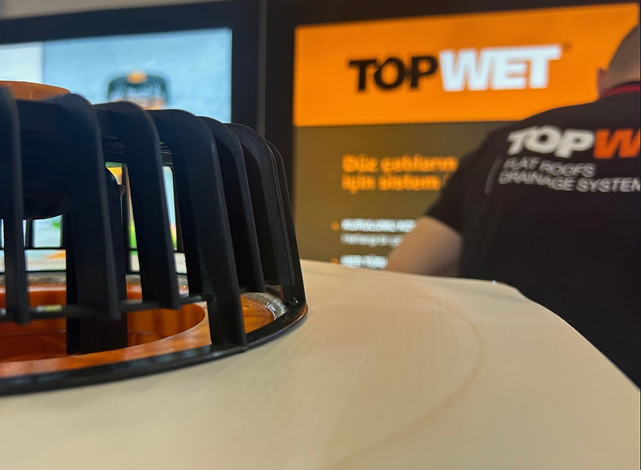
Opening hours for Christmas 2025 and January 2026
Wednesday 03/12/2025 – last accept order for delivery in this year
Friday 19/12/2025 – OPEN – 7:00 a.m. to 1:00 p.m.
Monday 22/12/2025 to Wednesday 07/01/2025 – CLOSED – ANNUAL INVENTORY
From Thursday 08/01/2025 – OPEN – 7:00 a.m. to 3:30 p.m. (standard operation)
Self-regulating heated outlets and gutter spouts
It functions in principle of resistance change between semiconductors in dependence on ambient temperature. Laically said, the lower temperature in outlet surroundings, the higher output the heating has. The highest risk of outlets or gutter spouts blocking is with temperatures around zero when so called ice plug of hoar-frost and snow may block outlets or even whole piping. Heating is designed to protect not only a mouth of the roof outlet but its immediate surroundings as well.

Advantages of self-regulating heating
- Reliable drainage also in winter season
- Voltage 230 V / 50 Hz – without necessity of a transformer or a control unit
- Option of connection to heating of gutters, downpipes, garage entries etc.
- Simple connection via a switch or a thermostat
- Electric energy saving
Heating connection and regulation
The self-regulating heating system increases its output according to the ambient temperature but in summer months it has a minimum electric input. Therefore we recommend to switch off the electricity supply when temperatures exceed +3 °C. We recommend setting the thermostats to +3 °C and placing the temperature sensor to the northern side or to another side without external influences.
Basic options of connecting of heated outlets
- Without possibility of switching off (energy consumption also in summer season – not recommended)
- Mechanical switch (manipulation required), or time socket
- Outer thermostat with integrated thermal sensor
- Thermostat to a switchboard including thermal sensor for measuring of outer temperature
- Thermostat to a switchboard including thermal and humidity sensor
Connection description
- Connection is performed in an electric box under roof structure
- Length of the outlet supply cable is 1.5 m. Cable CYKY 3 x 1.5 mm
- Wire connection: yellow-green – protective, black – phase, blue – neutraĺ
- AC voltage: 230 V, 50 Hz
- Protection class: IP 67
Roof outlets (TWE)
- Input power: variable according to the ambient temperature, approx. 16 W at 20°C / 21 W at 0°C / 27 W at -20°C
- Max. current surge: 600 mA
Roof outlets(TWNE), Refurbishment outlets and extended single-wall roof outlets (TWE SAN, TWJE), Terrace outlets (TWTE):
- Input power: variable according to the ambient temperature, approx. 10 W at 20°C / 14 W at 0°C / 18 W at -20°C
- Max. current surge: 400 mA
Gutter spouts (TWCE):
- Input power: variable according to the ambient temperature, approx. 4 W at 20°C / 5 W at 0°C / 7 W at -20°C
- Max. current surge: 150 mA
Balcony outlets(TWBE):
- Input power: variable according to the ambient temperature, approx. 3 W at 20°C / 4 W at 0°C / 5 W at -20°C
- Max. current surge: 100 mA

1 - main switch
2 - residual current device
3 - circuit breaker 1P max 10A
4 - thermostat or switch
5 -outlet
L - phase (brown)
N - neutral (blue)
PE - protective (yellow-green)